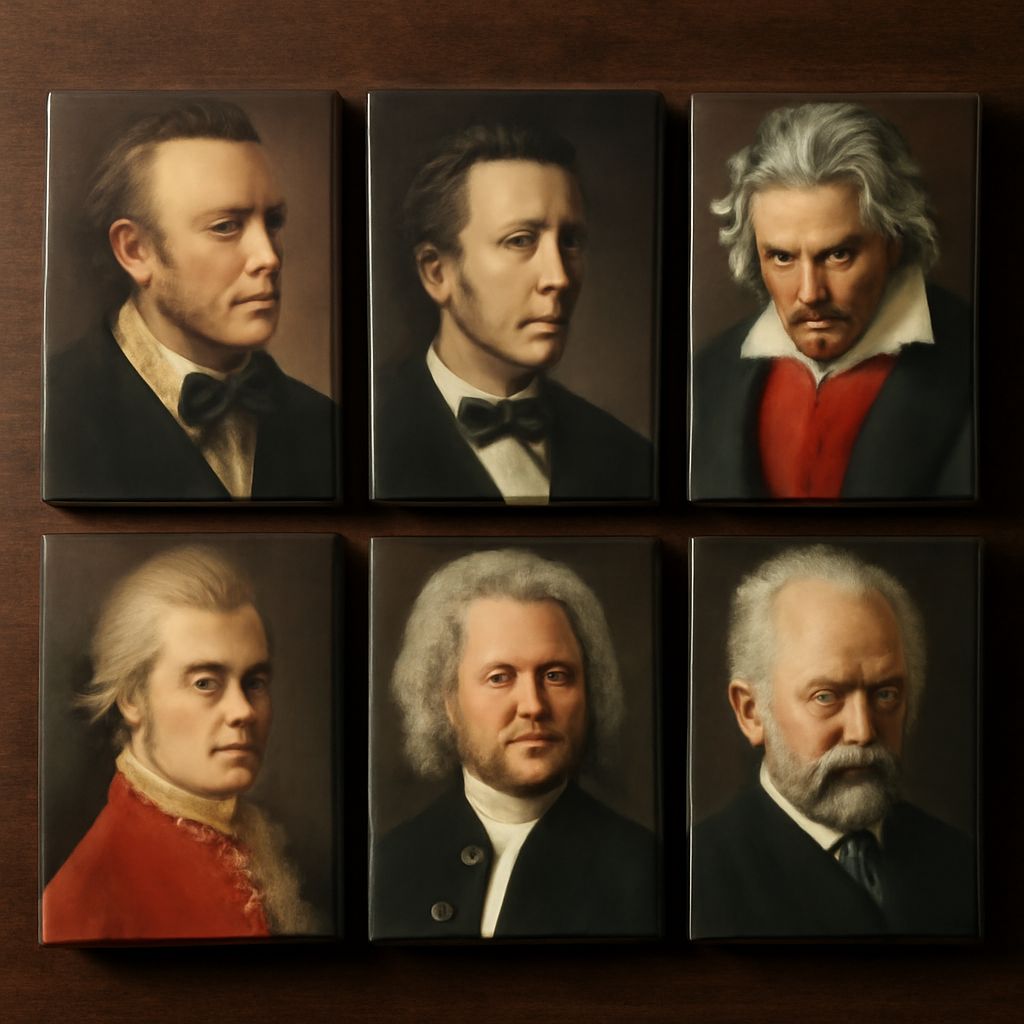
The top classical composers are best understood through the periods that shaped their musical language. This selective list of classical music composers follows the development from Baroque counterpoint to Classical balance, Romantic expression, and the varied modern traditions that followed.
For readers who search “composers classical,” the guide below provides a starting point for identifying important names, understanding their contributions, and choosing one representative work to hear first. It is a historical reference, not a ranking of artistic worth; period boundaries also overlap.
List of classical composers: Baroque foundations and common practice
From roughly 1600 to 1750, Baroque music established the tonal system that dominated European concert music for centuries. Composers emphasized contrast, ornament, basso continuo, counterpoint, and clear musical motion toward harmonic goals.
- Claudio Monteverdi: Helped transform early opera through expressive vocal writing and dramatic harmony. Start with L’Orfeo, one of the earliest operas still regularly performed.
- Antonio Vivaldi: Made the solo concerto more vivid through recurring ritornellos, energetic rhythms, and instrumental color. Hear The Four Seasons first.
- Johann Sebastian Bach: Reached extraordinary depth in counterpoint and tonal architecture across sacred, keyboard, and orchestral music. Begin with the Brandenburg Concerto No. 3.
- George Frideric Handel: Defined the English oratorio with powerful choruses, theatrical pacing, and accessible vocal writing. Messiah is the natural entry point.
Classical-era balance and form: top classical composers to hear
The Classical period, approximately 1750 to 1820, favored proportional phrases, transparent textures, and formal clarity. The symphony, string quartet, concerto, and sonata developed into flexible structures, especially through sonata form and thematic development.
- Christoph Willibald Gluck: Reformed opera by giving dramatic truth and natural vocal expression greater priority than vocal display. Try Orfeo ed Euridice.
- Joseph Haydn: Standardized and expanded the symphony and string quartet with wit, balanced themes, and inventive development. Hear Symphony No. 94, the “Surprise.”
- Wolfgang Amadeus Mozart: Combined formal control with remarkable melodic, dramatic, and emotional range in opera and instrumental music. Start with Don Giovanni.
- Ludwig van Beethoven: Enlarged Classical forms and intensified their emotional and structural force, leading toward Romanticism. His Symphony No. 3, “Eroica,” is an essential first listen.
Romantic composers and expanded expression
Nineteenth-century Romanticism placed greater weight on individuality, atmosphere, narrative, and emotional extremes. Harmony became more chromatic, orchestras grew, and composers explored nationalism, poetic imagery, virtuosity, and increasingly personal musical forms.
- Franz Schubert: Elevated the art song through memorable melodies, psychological storytelling, and intimate piano partnerships. Hear the song cycle Winterreise.
- Frédéric Chopin: Reimagined piano technique and color through expressive miniatures, dance forms, and poetic lyricism. Begin with the Ballade No. 1.
- Franz Liszt: Advanced piano virtuosity and helped establish the symphonic poem, linking instrumental music to extra-musical ideas. Try Les Préludes.
- Richard Wagner: Expanded opera into continuous music drama using leitmotifs, large orchestras, and adventurous chromatic harmony. Start with the prelude to Tristan und Isolde.
- Johannes Brahms: Preserved Classical structural discipline while deepening Romantic harmony, rhythmic complexity, and emotional weight. Hear Symphony No. 4.
- Pyotr Ilyich Tchaikovsky: Joined highly memorable melodies to expansive orchestration and dramatic emotional contrasts. His Symphony No. 6, “Pathétique,” is a useful introduction.
Modern and twentieth-century voices
Modern music, particularly from the early twentieth century onward, is not one unified style. Composers challenged functional tonality, rethought rhythm and timbre, drew on folk traditions, and sometimes returned deliberately to older forms. This makes the modern section of any list of classical composers especially diverse.
- Claude Debussy: Made harmony, resonance, and orchestral color central compositional materials, moving beyond traditional tonal direction. Hear La mer.
- Arnold Schoenberg: Developed atonality and the twelve-tone method, changing how composers organized pitch. Begin with Pierrot lunaire.
- Igor Stravinsky: Transformed modern rhythm and orchestral writing, while moving through Russian, neoclassical, and serial styles. Start with The Rite of Spring.
- Béla Bartók: Combined systematic study of Eastern European folk music with sharp modern harmony and rhythmic energy. Hear the Concerto for Orchestra.
- Dmitri Shostakovich: Used symphonic scale, irony, intense contrasts, and coded public-private expression within the pressures of Soviet life. Begin with Symphony No. 5.