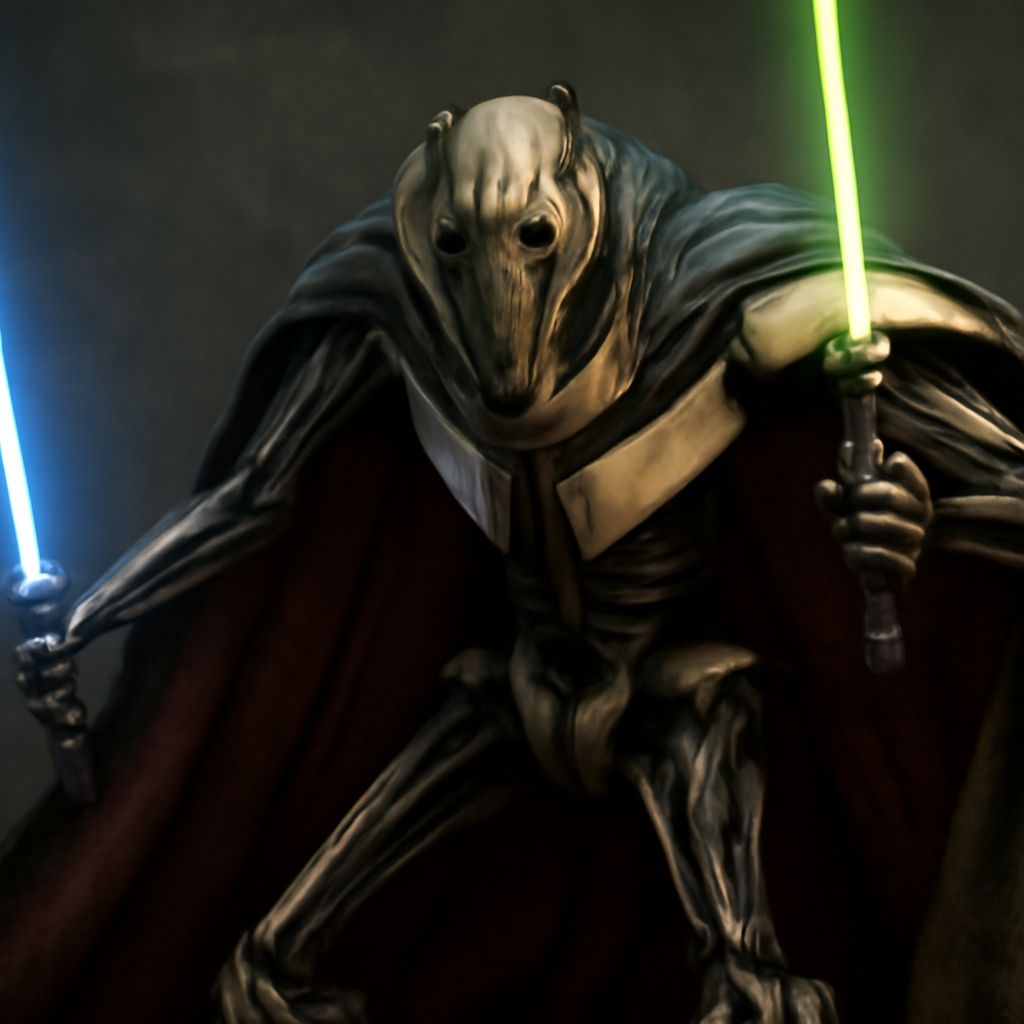
A row of lightsaber hilts hangs beneath General Grievous’s cloak before a single blade is lit. In Star Wars: Revenge of the Sith (2005), the weapons turn the cyborg commander into a walking record of encounters with Jedi. Grievous’s collection of lightsabers is both a threat to his opponents and a display of what he wants to take from them.
General Grievous Lightsaber Collection: What the Film Shows
Early in the film, Anakin Skywalker and Obi-Wan Kenobi are captured aboard the Separatist flagship Invisible Hand. Grievous takes their weapons and promises to add them to his collection. The Jedi soon recover the sabers during their escape, so the scene establishes temporary possession rather than two permanent additions. StarWars.com highlights the exchange and treats the identities of the other weapons under his cloak as an open question.
The General Grievous lightsabers carry an unsettling implication: weapons associated with Jedi are now displayed by a hunter of Jedi. Grievous does not need to recount each encounter. The sight of several hilts, gathered on one body, lets the audience infer a history of conflict before the film shows his fighting style.
The General Grievous lightsaber collection contains weapons with different histories. The movie confirms that he has multiple weapons and briefly takes those of Anakin and Obi-Wan. It does not pause to identify the former owner of each hilt he later uses. A resemblance between two props can invite comparison, but a visual match alone is a weak basis for assigning a weapon to a particular Jedi.
Four Blades on Utapau
When Obi-Wan confronts Grievous on Utapau, the general’s mechanical arms divide into four. Each of Grievous’s hands produces a lightsaber, and four blue and green blades surround a single opponent. The official character entry confirms that he fights Obi-Wan with four weapons at once and has been trained in lightsaber combat by Count Dooku.
The staging turns a physical design into a tactical problem. Grievous rotates the blades in front of him, making a moving barrier that threatens to overwhelm the space between the fighters. Obi-Wan’s single blade and compact defensive movements provide a clear visual counterpoint. The audience can read the imbalance immediately: one fighter has multiplied his reach, while the other has to find an opening inside the machinery.
Grievous’s lightsabers also expose the gap between intimidation and control. Obi-Wan does not need to meet all four blades indefinitely; he attacks the arms that wield them. As Grievous loses hands, the spectacle contracts into a chase and a close struggle. The weapons establish his apparent advantage, but the changing number of blades gives the fight a visible progression.
A Named Weapon in the Lair
The Clone Wars offers a more specific example of a saber in Grievous’s collection. In “Lair of Grievous,” Kit Fisto and Nahdar Vebb enter the general’s fortress and encounter the trophies kept there. Fisto examines a lightsaber that he recognizes as belonging to Jedi Master Neebo. The official episode rewatch identifies Neebo and says he disappeared while defending refugees on the moons of Sanjin.
That detail gives the objects a human cost without requiring the audience to invent the circumstances of every loss. Neebo’s weapon is a confirmed item in the lair; the episode summary does not establish that it was one of the four used against Obi-Wan in the film. The distinction between a documented trophy and a particular screen-used weapon keeps the evidence clear.
Another documented encounter involves Eeth Koth. In “Grievous Intrigue,” the general captures the Jedi Master, who is later rescued. The official episode guide confirms the capture and rescue; a secondary catalog of the collection identifies Koth’s saber as a weapon taken and recovered. That temporary loss should not be treated as proof that Koth died or that his saber remained with the general on Utapau.
Trophies, Training, and Character
The General Grievous lightsabers are effective because they combine personal history with spectacle. Their Jedi associations make the display provocative: Grievous uses an opponent’s symbol of discipline as evidence of conquest. The lightsabers collected by General Grievous are also practical, giving him several weapons to deploy through a body built for speed and force.
Training supplies another layer. Grievous is not presented as a Jedi; the official character entry describes Dooku teaching him lightsaber combat. The blades therefore make him a dangerous opponent without requiring the film to present him as a user of the Force. His mechanical movement and habit of retreating when a battle turns against him shape a villain whose threat comes from a combination of technique, machinery, and opportunism.
The collection of sabers belonging to Grievous can also be read as a contrast with Obi-Wan’s relationship to his own weapon. Obi-Wan carries one blade into the Utapau duel; the general displays an arsenal. The difference gives the scene a simple visual structure before either fighter strikes.
Where Did the Sabers Come From?
Some of the lightsabers Grievous carried or stored were taken from Jedi, including weapons he held only briefly. Neebo’s saber is specifically identified in the animated series’ official material; the individual former owners of the four Utapau blades are not established by the film itself. The strongest answer is therefore a combination of confirmed trophies and unresolved details, not an invented complete inventory.