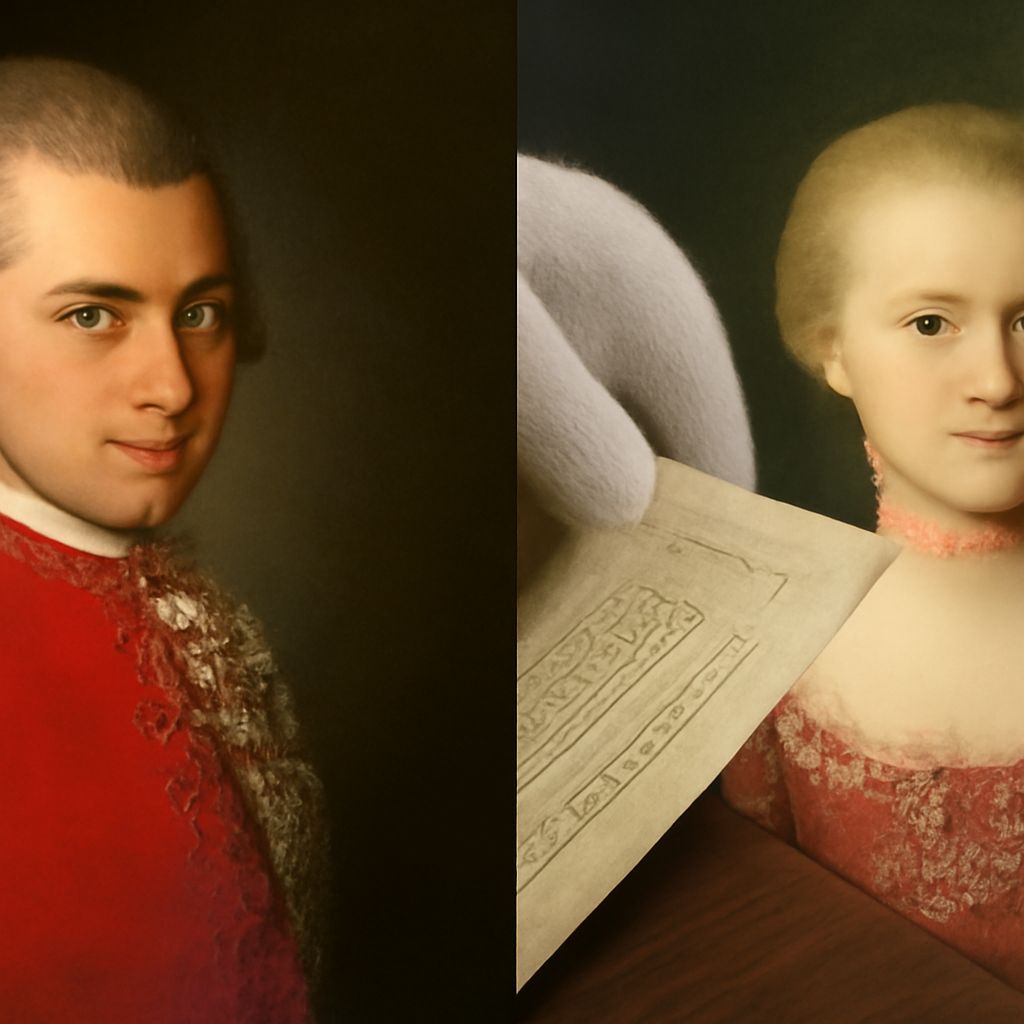
Maria Anna Walburga Ignatia Mozart, known to history as Nannerl Mozart, was more than just the elder sibling of Wolfgang Amadeus Mozart. Often overshadowed by her famous brother, Nannerl was a prodigiously talented composer and pianist in her own right. Her story presents a remarkable but often overlooked perspective on the world of classical music, shedding light on the challenges faced by gifted women in the 18th century. This article explores the life of Mozart’s sister, her early promise, the barriers she encountered, and her enduring legacy in Western music history.
Who Was Mozart’s Sister?
When people hear the name Mozart, they typically think of Wolfgang Amadeus, yet his older sister, Nannerl Mozart, was an outstanding musician whose achievements drew widespread admiration during her youth. Born in Salzburg in 1751, Maria Anna “Nannerl” Mozart was the first child of Leopold and Anna Maria Mozart. From an early age, she exhibited extraordinary musical ability, studying under her father alongside her younger brother.
Nannerl’s significance as Mozart’s sister goes beyond familial ties. She was a celebrated harpsichordist and pianist, attracting attention in the courts of Europe. As children, she and Wolfgang performed together as a duo, impressing audiences in Munich, Vienna, Paris, and London. While Wolfgang went on to be hailed as a musical genius, Nannerl’s own artistry—described as elegant and expressive—was highly praised by contemporaries.
Despite her gifts, much of Nannerl’s life and career remains shrouded in mystery, with far fewer surviving records than those of her brother. Still, what is known points to a figure whose creative contributions and personal sacrifices shaped the Mozart family’s musical legacy.
Nannerl Mozart’s Early Life and Musical Talents
Nannerl Mozart’s immersion in music began in early childhood. By the age of seven, she had mastered complex keyboard works and was composing her own pieces, according to her father Leopold. These early achievements prompted Leopold to take both his children on a “Grand Tour” of Europe, where they performed at royal courts and for the public. Nannerl’s skill as a pianist and harpsichordist was reputed to be on par with, and sometimes even surpassing, her brother’s at that time.
Nannerl’s musical education was rigorous and comprehensive. She studied keyboard technique, counterpoint, sight-reading, and composition. Letters from Leopold Mozart reveal that he was deeply proud of Nannerl’s abilities and often showcased her talent to influential patrons. Audiences marveled at her technical prowess and interpretative nuance, noting her poise and musical intelligence.
Unfortunately, no complete compositions by Nannerl have survived, though references in family correspondence suggest she wrote pieces for keyboard and possibly for small ensembles. Some music historians speculate that parts of her work may have influenced Wolfgang’s compositions, given their close collaboration and mutual respect during childhood.
During their joint performances, the siblings developed a close artistic bond and a shared love for music. Their father’s devotion to their education fostered an environment in which Nannerl thrived—at least while she remained within the family circle and under his tutelage.
Challenges and Limitations Faced by Nannerl
Despite her prodigious talent, Nannerl Mozart’s path diverged sharply from that of her brother due to societal expectations and family pressures. In 18th-century Europe, women from respectable families were not encouraged to pursue public careers in music. As Nannerl entered adolescence, her touring and public performances were curtailed by her father, who believed it was no longer appropriate for her to travel and perform on stage.
As a result, while Wolfgang continued to tour and ultimately built a legacy as a composer, Nannerl’s opportunities dwindled. She remained in Salzburg, giving private lessons and playing in domestic settings, but was effectively shut out from the broader professional world of classical music. The contrast between the siblings’ prospects highlights the gender barriers that shaped musical careers in their era.
Nannerl’s role within the family shifted as well. She became responsible for household duties after her mother’s death and later cared for her aging father. In 1784, she married Johann Baptist Franz von Berchtold zu Sonnenburg, a magistrate, and moved to St. Gilgen, where her musical activities further decreased amid domestic responsibilities.
These limitations were not unique to Nannerl; they reflected the reality for most women musicians of the time. Nonetheless, her curtailed career stands as a poignant example of lost potential and the cultural constraints placed on even the most gifted female artists.
Nannerl Mozart’s Legacy in Classical Music
Although Nannerl Mozart’s own compositions have not survived, her influence endures through her role as an early mentor and inspiration to Wolfgang Amadeus Mozart. Her musical partnership with her brother during their formative years helped foster his genius and undoubtedly shaped some of his earliest works. Historians and musicians today are rediscovering Nannerl’s story, recognizing her as a significant figure in classical music history.
Interest in Nannerl has grown in recent decades, with scholarly research, biographies, and even films exploring her life and achievements. Musicians and feminist historians often cite her as a symbol of both the underrecognized talent of women in music and the importance of acknowledging hidden figures whose contributions have been overlooked.
Nannerl Mozart’s life challenges modern audiences to reconsider the stories behind the great names in classical music. Her legacy is preserved not just in surviving anecdotes and records, but in the inspiration she provides to new generations of musicians and advocates for gender equality in the arts.