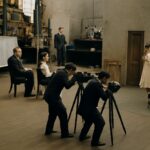
A master take records a scene’s principal action continuously, giving the editor a view of how people and objects relate in space. An example of a master take can show why that matters: when a character crosses a room to deliver bad news, the distance traveled may carry as much tension as the words.
A Scene’s Full Span
A master shot typically covers the action of a scene from beginning to end. It often uses a wide enough frame to include the key performers and their movements, though the camera can move or change framing as the scene unfolds. Its defining job is coverage of the action, not a particular lens or a motionless camera.
That continuous view gives a director a way to stage relationships. Two people at opposite ends of a table may appear guarded; one person’s decision to stand and approach can change the balance before either speaks. The editor can preserve that movement in full or interrupt it with another angle. Either choice has a visual foundation.
A continuous scene setup differs from an establishing shot. An establishing shot usually introduces a location and helps orient the viewer; it need not record the whole scene. One image can do both jobs, but a street view outside a restaurant followed by a conversation inside is an establishment, not coverage of that conversation.
Master Shot Example: A Letter Across the Room
Consider a fictional scene devised for illustration. In a quiet kitchen, Mara stands by the sink. Her brother Daniel sits at a table near the door, a sealed letter in front of him. A wide camera position includes both people, the letter, the sink, and the doorway. The scene plays through in one continuous take:
- Daniel slides the letter toward the empty chair opposite him.
- Mara notices it but continues drying a plate.
- Daniel says their father has sold the house. Mara puts the plate down and crosses to the table.
- She opens the letter, reads silently, and looks toward the door. Daniel stays seated.
In this master shot example, the opening frame makes the distance between the siblings visible. The letter sits between them before Mara moves; her crossing turns that distance into an action. When she looks toward the door, the audience already knows where it leads out of the room, and Daniel’s stillness remains visible beside her.
A worked example of a master take also shows what the wider frame may withhold. From across the kitchen, the viewer can see that Mara reads, but perhaps not the change in her expression. The writing on the letter may be too small to decipher. Those limits suggest where closer coverage might serve the scene.
Adding Angles for the Edit
Coverage is the collection of shots available to construct a scene. Alongside the full run, the crew might film a close-up of Mara as she reads, a close-up of Daniel waiting, and an insert—a closer view of the letter or a hand placing it on the table. Each shot offers a different piece of information. A close-up can draw attention to a fleeting reaction; an insert can make a detail legible or place emphasis on a gesture.
For this example of master-take coverage, imagine that Mara’s face barely changes as she reads. A cut to her eyes could make the pause intimate. A cut back to the wider view could then show her turning toward the door while Daniel remains at the table. The change in scale alters what the audience attends to, while the return restores their relationship in the room.
The editor does not have to begin with the wide view or use every angle. Starting on the letter could delay the revelation of who is holding it; staying with Mara’s face might keep Daniel’s reaction hidden. Cutting back to the master shot at the moment she crosses the room, however, lets the movement play against the distance established earlier. The choice is expressive as well as practical.
Continuity and Screen Direction
The separate takes must fit together if the scene is meant to feel continuous. In the kitchen, the plate should be in a compatible position when the edit moves between angles, and Mara’s hand should reach for the letter at a matching moment. Dialogue, pauses, and eye lines also provide points where one take can connect to another. A reaction can bridge a small mismatch.
A useful guide for camera placement is the 180-degree line: an imaginary axis through the principal subjects or direction of action. Keeping cameras on one side generally preserves their left-to-right relationship on screen. A filmmaker can cross the line deliberately, for instance by showing the camera movement across it, but an unexplained change can make the characters appear to swap places.
In the kitchen scenario, the line between Mara and Daniel changes as she walks to the table. Planning closer angles around her new position helps the editor maintain clear eye lines. Master shots give the crew a reference for this geography, while rehearsal reveals when an actor or a prop might block an intended view.
When to Keep the Wider View
A master take can carry an entire scene in the finished film, but it need not appear there in full. A director may favor close views for intimacy and use only a short portion of the continuous setup. Another may stay wide to show: Mara reading, Daniel waiting, and the doorway behind them.
Examples of master takes can be simple or elaborate. A fixed frame may let performers move through a carefully arranged space; a moving camera may follow them and discover new relationships. The choice depends on what the scene needs the audience to see, and whether the movement can be staged clearly.
The kitchen example of a master take earns its place when the whole arrangement matters: Mara’s hesitation, Daniel’s silence, and the space between them all remain visible. A closer angle can then isolate the moment her eyes settle on the letter. The cut changes the scale of attention without erasing the room in which that attention was earned.