
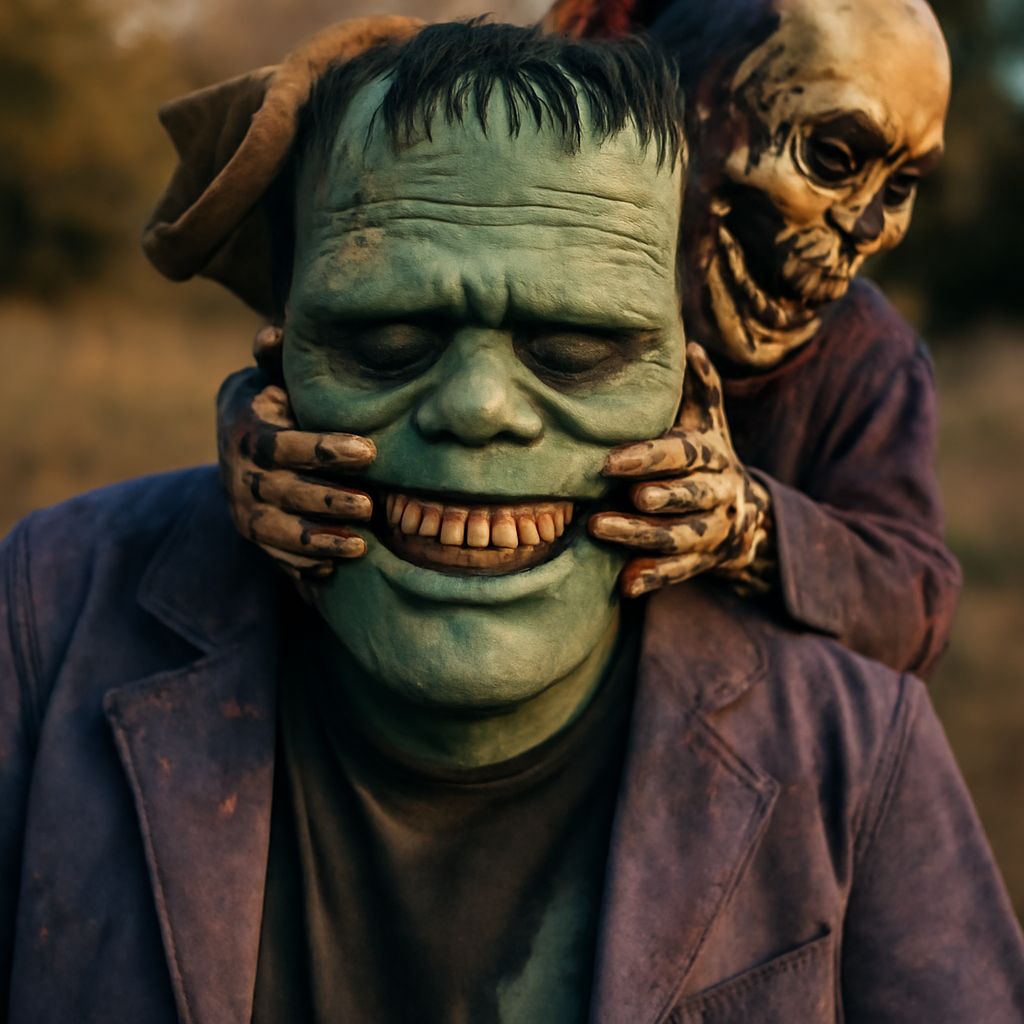
The name of Frankenstein’s monster is never given in Mary Shelley’s novel. Victor Frankenstein is the scientist who creates the being, so “Frankenstein” names the creator, not the creation. The Creature is the clearest neutral name for him, although Shelley also has characters call him a monster, daemon, wretch, or fiend.
This creator-versus-creation confusion largely comes from adaptations and everyday shorthand. When people say “Frankenstein” to mean the monster, they are using Victor’s surname as a label for the character he made, not following the novel’s naming.
The Name of Frankenstein’s Monster: The Creature, Not Frankenstein
In the novel, Victor never gives his creation a personal name. He refers to him through descriptive and emotional terms, including “the being,” “the daemon,” “the wretch,” and “the monster.” The Creature himself also does not introduce himself with a name. His lack of a name reinforces one of the novel’s central problems: Victor brings him to life but refuses to accept responsibility for him.
Calling him “Frankenstein’s Creature” or “the Creature” avoids the confusion. “Frankenstein’s monster” is also an established and understandable label, but it describes the relationship between the two characters rather than identifying a personal name. Victor Frankenstein is the creator; the Creature is his creation.
The Creature is not a mindless villain in Shelley’s story, either. He learns language, reads widely, reasons about justice, and expresses grief and loneliness with unusual intelligence. His violence develops through rejection, abandonment, and revenge, which makes him more psychologically complex than the silent figure often shown in films.
Mary Shelley’s Description of Frankenstein’s Monster
A useful description of Frankenstein’s monster must come from the novel rather than from the familiar film makeup. Victor says the Creature is approximately eight feet tall and proportionately large. He originally chooses what he considers beautiful features, but once the body is animated, those features combine into a horrifying whole.
Shelley’s most important physical details include yellow skin that barely covers the muscles and arteries beneath it, lustrous black hair, pearly white teeth, watery eyes, a shrivelled complexion, and straight black lips. Victor describes the Creature’s eyes as almost the same color as the dun-white sockets around them. The contrast between attractive individual features and the assembled body’s overall appearance is what disturbs him most.
The novel does not describe the Creature with a flat-topped head, neck bolts, or a line of surgical scars. Those details belong primarily to later visual adaptations. Shelley also emphasizes his physical strength and speed: he can survive harsh conditions, climb through difficult terrain, and travel across mountains and ice. His size and abilities make him threatening, but his eloquence gives him a human emotional and intellectual presence.
Where Igor, the Hunchbacked Assistant, Came From
Igor is not a character in Mary Shelley’s original novel. The book contains no Igor, no Fritz, and no hunchbacked laboratory assistant working beside Victor. The assistant figure developed through stage and film adaptations that wanted to make the laboratory more theatrical and give the isolated scientist a subordinate or comic companion.
Richard Brinsley Peake’s 1823 stage melodrama Presumption; or, the Fate of Frankenstein introduced a servant named Fritz. That production helped establish the idea of a helper connected with Frankenstein’s experiments. The 1931 film Frankenstein also used the name Fritz for Victor’s assistant, played by Dwight Frye. His hunched, nervous performance contributed to the visual tradition later associated with a hunchbacked assistant.
The name most closely linked with the later tradition arrived in Son of Frankenstein (1939). Bela Lugosi played Ygor, a twisted-neck grave robber who assists Wolf Frankenstein. Later stories and parodies often respelled Ygor as Igor and blended his traits with those of Fritz. That combination produced the familiar “Igor” character: a bent, sinister assistant carrying equipment or helping in a secret laboratory.
How Adaptations Changed Frankenstein’s Monster
Film adaptations reshaped both the Creature and the world around him. Universal’s 1931 Frankenstein, with Boris Karloff in the title role and makeup by Jack Pierce, established the flat head, forehead scar, heavy eyelids, neck electrodes, and clumsy movements now associated with Frankenstein’s monster. These features are so influential that they often replace Shelley’s original description in popular memory.
The films also commonly make the Creature silent or nearly silent, while Shelley’s Creature speaks persuasively and at length. In the novel, he tells Victor about his education, his observations of the De Lacey family, and his desire for companionship. Adaptations may preserve his tragic origins while changing his speech, intelligence, appearance, and relationship with the scientist.
As a result, the modern image combines several different sources: Shelley’s unnamed, articulate, eight-foot-tall Creature; the stage servant Fritz; the film assistant Fritz; and Ygor from Son of Frankenstein. Keeping those elements separate explains why the Creature is not named Frankenstein and why Igor belongs to adaptation history rather than to the original novel.